
Spherical Bridge Bearings
Spherical bridge bearings are one type of bridge bearings with large rotation capacity. Similar to POT Bearing, spherical bearing also can be divided into three types: fixed spherical bearing, guided spherical bearing and free sliding spherical bearing. With a highly strengthened steel body, spherical bearing is especially designed for high vertical, horizontal and lateral loads and where large rotational structural displacements need to be accommodated.
Spherical Bearings are suitable for all types of Structures especially for long Span and continuous structures, Cable Stay and Suspension Bridges with relatively large and repetitive rotation and translation requirements caused by variable loads, and for superstructures that induce fast sliding displacements in bearings, e.g. in case of Road cum Railway Bridges.

Types Of Spherical Bearings
- Fixed Type Spherical Bearing
- Sliding In Transvers Direction Bearing
- Sliding In Longi/Traffic Direction Bearing
- Sliding In Both Direction
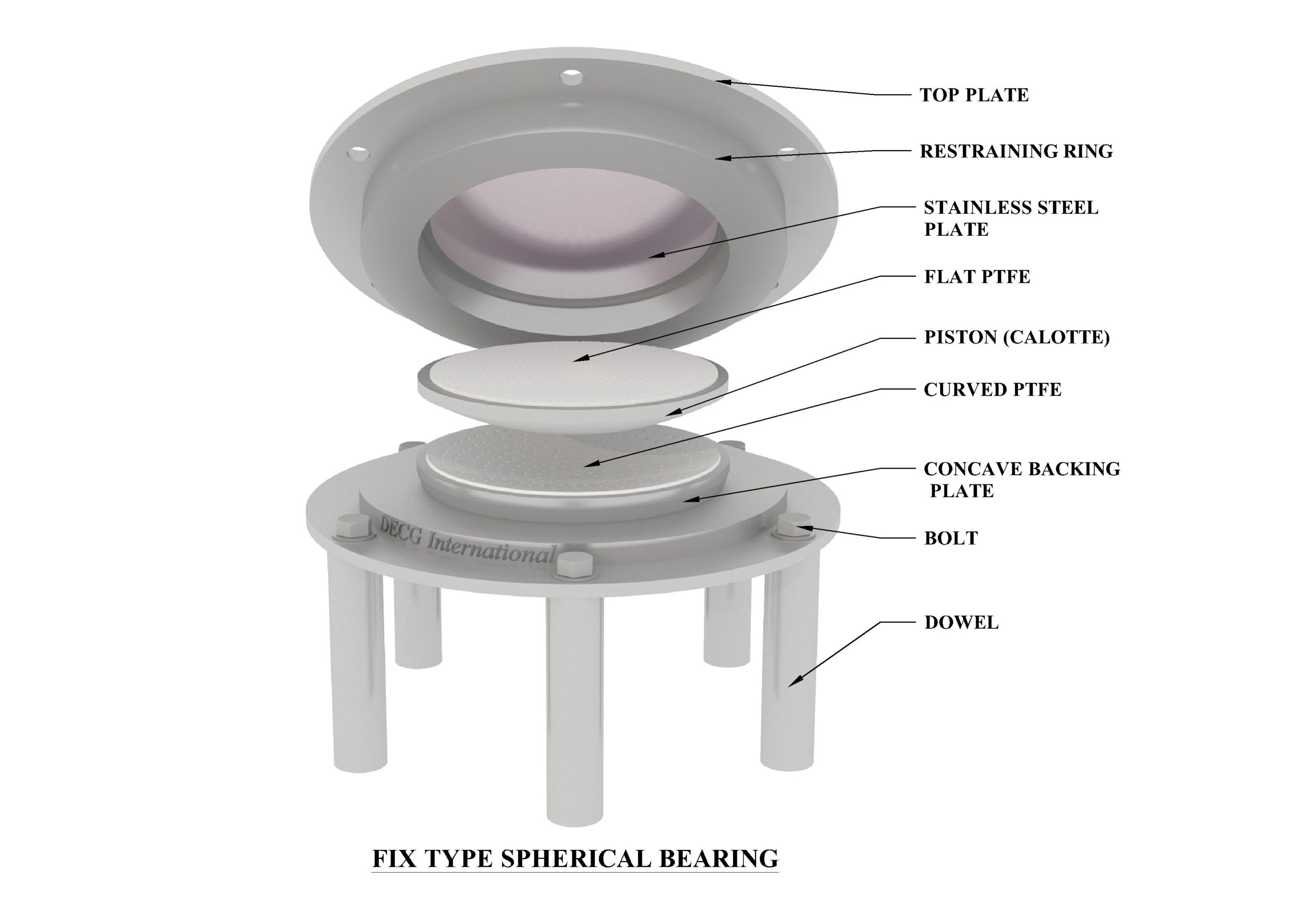
Fixed Type Spherical Bearing
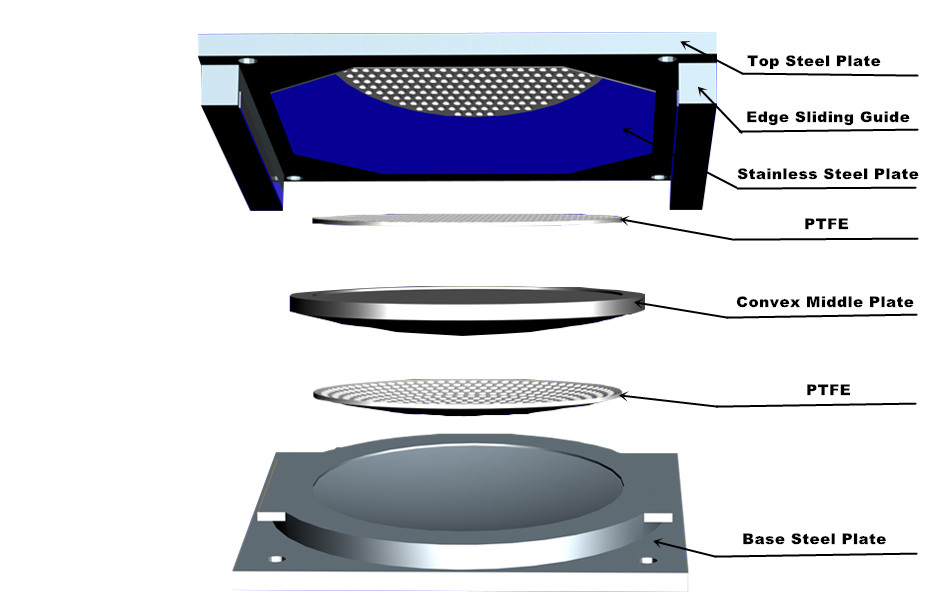
Sliding in Transverse Direction Bearing
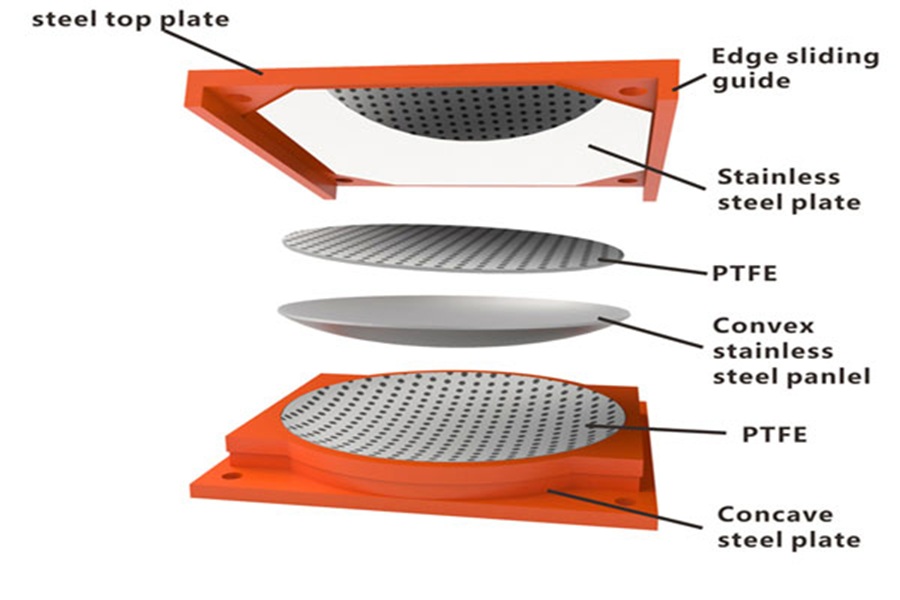
Slidding in Longi/Traffic Direction Bearing
Sliding in Both Direction
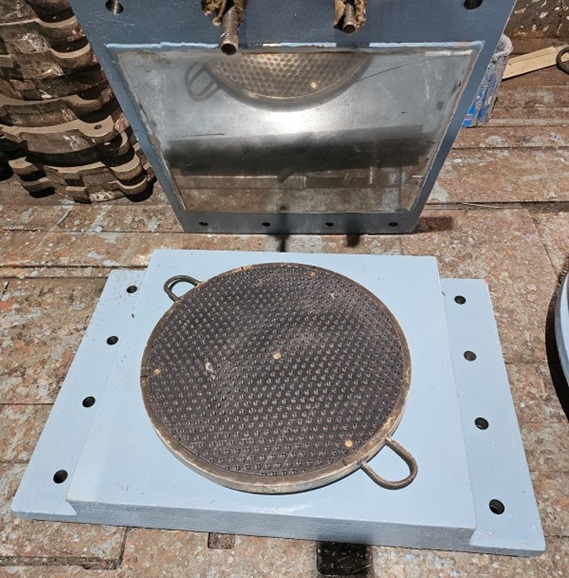
Base Plate: Steel Plates of the Bearing Assembly at Top & Bottom interfaced with the structure Concrete / Steel member.
Mating Surface: Flat or curved hard smooth surface of stainless steel, polished steel or chrome plated sliding against the PTFE (Polytetrafluoroethylene) or other low friction thermoplastic material.
Sliding Surface: PTFE or UHMWPE (Ultra High Molecular Weight Polyethylene) low friction thermoplastic material mounted on flat or curved backing plate providing low friction sliding to the mating surface.
Sliding Interface: Combination of mating & sliding surfaces providing relative low friction sliding displacement.
Working Principle of Spherical Bridge Bearings
Spherical bearing is formed by top steel plate, stainless steel slide, PTFE slide, convex plate, curved PTFE and concave plate. The sliding of convex plate and concave plate can accommodate the structural rotations of the beam end.
The stainless-steel slide and PTFE slide can further reduce friction coefficient; thus displacement of expansion and contraction can be accommodated. While, depending on whether the spherical bearing is fixed, guided or free sliding, the vertical loads, horizontal forces, longitudinal movements or transverse movements can be accommodated. What’s more, the guided bar and the restraining ring also can transmit the horizontal forces. Thus, spherical bearings are especially suitable for more complex bridges.
Maintenance of Spherical Bridge Bearings
During using, the spherical bearing needs to be inspected and maintained regularly. And the inspection items are as following:
- Checking whether the anchor bolt is cut and the rubber sealing is cracking and aging.
- Checking whether the relative displacement of the spherical bearing is uniform and record the displacement one by one.
- Clean the debris and dust around the spherical bearing, while at the same time, using the cotton cleans surface of the stainless steel.
- Loose the anchor nut regularly, clean and oil the anchor nut to avoid rust, and then fasten the anchor nut.
- Check the height changing of the spherical bearing to confirm the abrasion condition of the PTFE slide. And when the height of spherical bearing changes over than 3 mm, the rubber sealing should be removed to inspect the condition of the PTFE slide.
- Painting the steel components of the spherical bearing regularly to avoid rust destroy (except the stainless steel slide)
